
By Ines Aviles-Spadoni, M.S., M.A., Research/Communications Coordinator, UFTI
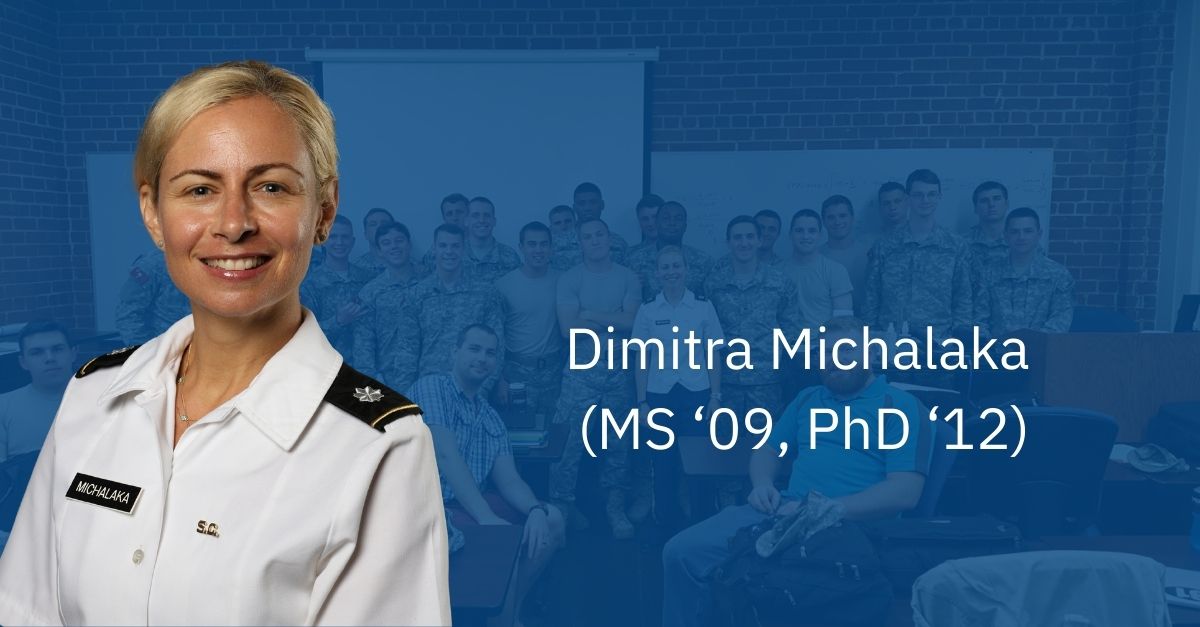
Two-lane roads were the main source of transportation infrastructure on Lesvos, a Greek island in the Aegean Sea, where Dimitra Michalaka was born. At age 12, while traveling through Italy with her family, she remembers sitting at the back of a tour bus, watching bridges crossing valleys and passing through tunnels cut through vast mountains.
“I didn’t yet know the term ‘transportation engineering,’ but I knew I was intrigued by how these systems were designed and how seamlessly they connected people and places,” Michalaka said.
That curiosity at a young age, combined with her love for mathematics, set her on an academic journey that led her to a passion for teaching as a professor of civil engineering at The Citadel in Charleston, South Carolina.
Michalaka did her undergraduate studies at the National Technical University of Athens (NTUA) in Athens, Greece. There, she studied civil engineering, and when she had to declare her major in her third year, transportation felt like a natural fit.
But transportation engineering did not really gel as a professional calling until a faculty member at NTUA encouraged her to apply to the University of Florida (UF) transportation engineering program in the Department of Civil and Coastal Engineering.
“Near the end of my undergraduate studies, I worked on a transportation-related thesis with Dr. Matthew Karlaftis at NTUA,” Michalaka said. “Through that collaboration, he encouraged me to pursue graduate studies and suggested the University of Florida’s transportation engineering program as one of the best in the world.”

Initially, Michalaka did not want to attend UF because leaving her family and the comfort of her country felt overwhelming. Nevertheless, she challenged herself and, after some persuasive conversations, she decided to give it a go.
“I decided to apply to UF for a master’s degree, telling myself I would go for just one year,” Michalaka said. “While my application was under review, I attended the Transportation Research Board (TRB) Annual Meeting, where I met Dr. Lily Elefteriadou and Dr. Alexandra Kondyli, who was a UF graduate student at the time. Their encouragement and reassurance helped solidify my decision.”
In 2007, Michalaka began her graduate studies at the UF. She studied under the guidance of Yafeng Yin, Ph.D., who was at UF at the time and who is now chair of the Department of Civil and Environmental Engineering at the University of Michigan in Ann Arbor. Under Yin, who served as both Michalaka’s master’s and doctoral adviser, she found an environment rich in collaboration and intellectual stimulation. A highlight of her master’s studies was winning the Council of University Transportation Centers (CUTC) Milton Pikarsky Memorial Award, which recognized her master’s thesis as the best in transportation science and technology.
Michalaka says that as an international student, the support she received from UF’s International Center, specifically from Debra Anderson, former director of UF’s International Student Support Services, gave her a sense of community and support far from home.
“I had never experienced such a collaborative, welcoming, and intellectually vibrant environment, especially one so rich in international perspectives,” Michalaka said. “Their efforts brought international students together, fostered a strong sense of community, and created opportunities for us to learn from and support one another.”
Michalaka added that the support of fellow transportation graduate students at UF, especially her lifelong friend, Kondyli, along with encouragement from staff, such as Ines Aviles-Spadoni, made her also feel at home.
As she was nearing the end of her master’s studies, she knew her time at UF was far from complete. Michalaka wanted more.
“I realized that my time at UF was not nearly enough,” Michalaka said. “Dr. Elefteriadou offered me the opportunity to work on research projects and asked if I would like to teach an undergraduate transportation engineering course.”
That teaching experience immediately awakened a passion in Michalaka, which led her to pursue doctoral studies in transportation engineering at UF once again under Yin’s guidance. Upon graduation, she was immediately hired as an assistant professor at The Citadel.
Today at The Citadel, Michalaka is a professor of civil, environmental, and construction engineering. Her childhood curiosities, combined with academic training at UF have shaped her teaching philosophy at The Citadel. She says she also credits Siva Srinivasan, Ph.D., professor and associate director of the University of Florida Transportation Institute (UFTI); Scott Wasburn, Ph.D., formerly at professor at UF and now a senior transportation engineering at WSB, a consulting firm in Orlando, Florida; and Ruth Steiner, Ph.D., a professor in the UF Department of Urban and Regional Planning, for serving as role models helping to shape her teaching philosophy.
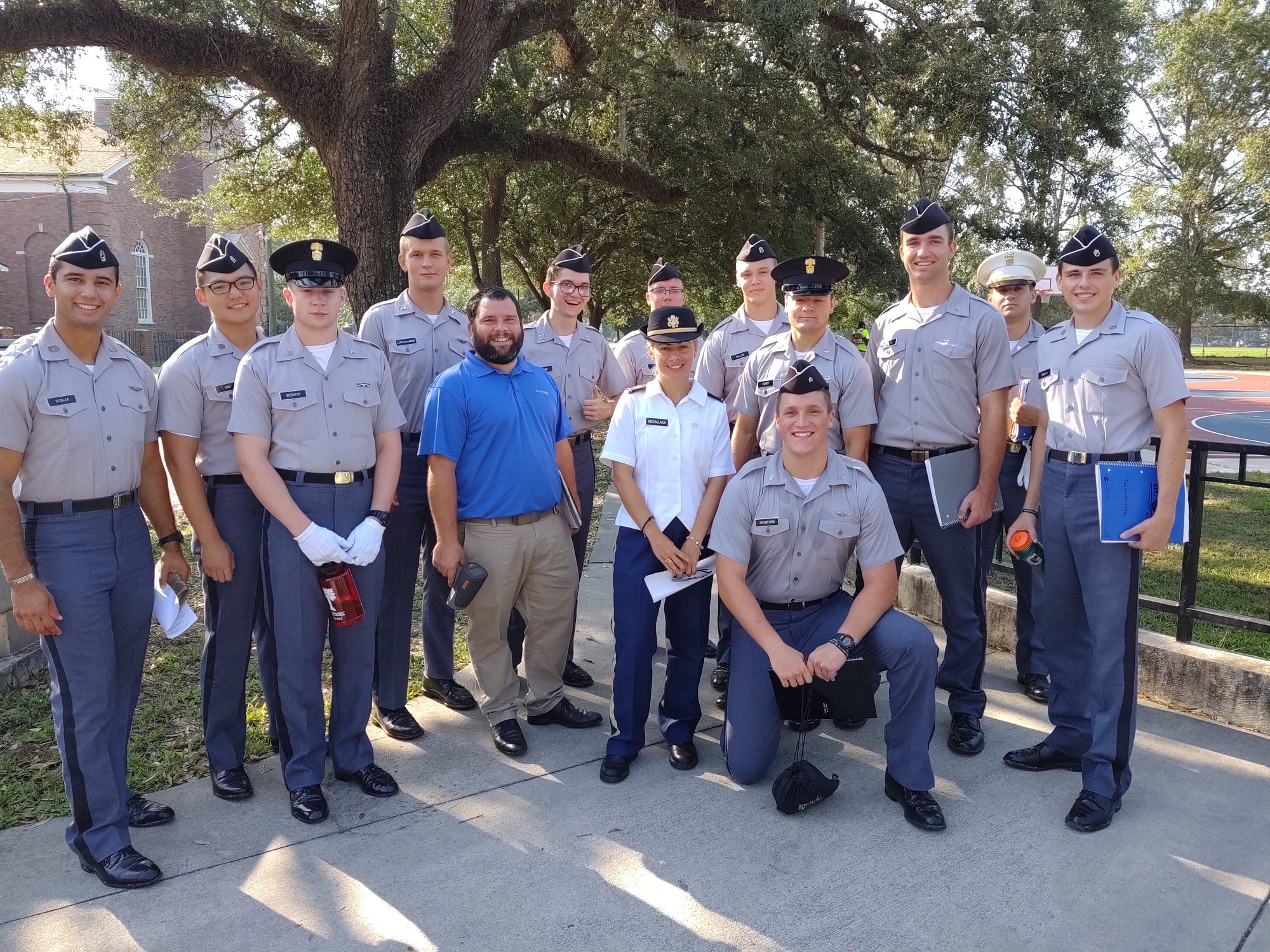
Michalaka teaches a variety of courses to cadets at The Citadel. She says it’s both a demanding and structured environment, yet one she describes as rewarding. The institution’s academic standards are the same as those at civilian institutions of higher learning, but honor, duty, and respect reign in the classroom, and class attendance is mandatory.
“At The Citadel, I combine clear, structured expectations with supportive mentorship, ensuring that all students, cadets and civilians alike, master the technical material while also understanding its ethical and societal implications,” she said. “UF’s emphasis on both excellence and empathy equipped me to uphold these shared standards and to help students thrive academically, professionally, and as future leaders.”
She says that being a part of a diverse and international academic community at UF taught her how to work with students from many different backgrounds, learning styles and experiences. She also says that while at UF, she observed many outstanding faculty members who “modeled excellence, empathy and adaptability in the classroom.”
“At UF, I had the opportunity to teach both undergraduate and graduate transportation courses, including Transportation Engineering and Transportation Systems Analysis,” Michalaka said. “Those early teaching experiences, guided by exceptional mentors, helped me understand that effective teaching goes beyond delivering technical content. It requires clear objectives, strong communication, active engagement, and, most importantly, genuine care for students.”
“I emphasize real-world applications, active learning, and open dialogue, creating an environment where students feel supported, respected, and motivated to learn,” she said. “UF gave me both the foundation and the inspiration to build a teaching philosophy that continues to evolve with every class I teach.”
Looking to the future, Michalaka has some words of wisdom for students thinking about a career in academia.
“My advice is simple: Choose a path that aligns with what you truly enjoy,” Michalaka said. “If teaching excites and energizes you, institutions that prioritize education can be deeply fulfilling. If research and advancing knowledge are your primary passions, research-focused institutions may be the right fit.”